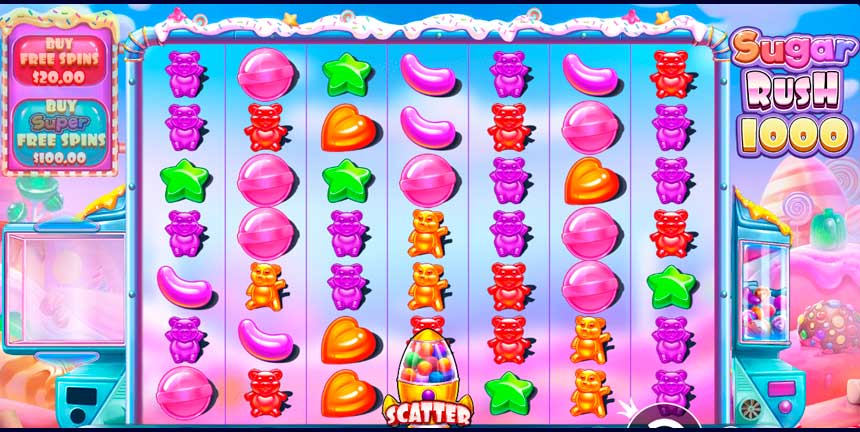
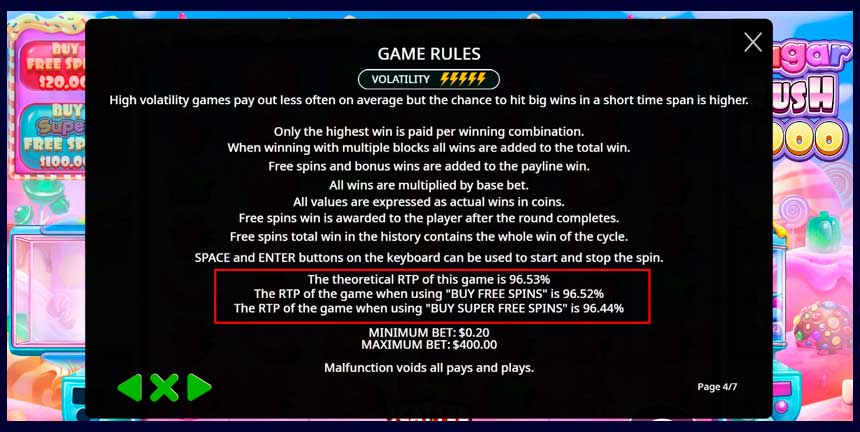
Sugar Rush 1000 RTP on Duel: 96.53% in the base game, 96.52% for the Buy Free Spins and 96.44% for the Buy Super Free Spins. Both buys run below base, so base play is the top mode — and the badge shows the same 96.53%.
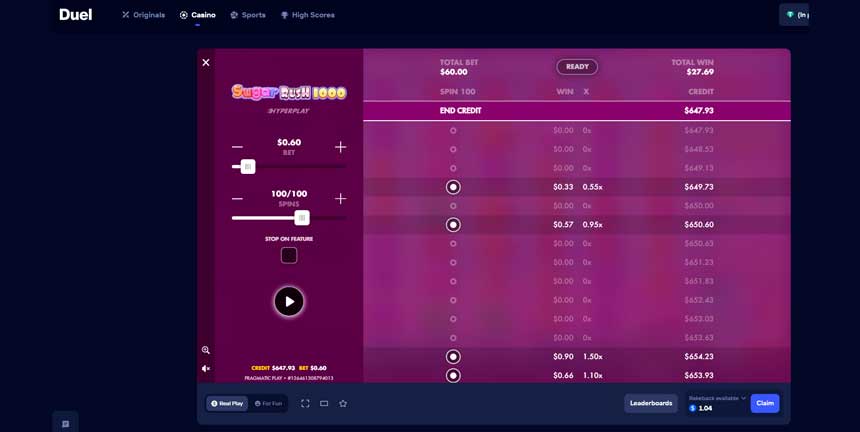
Rakeback: $1.04 accrued on $60.00 wagered — the prediction to the cent. Status: Matched.
What it costs you: the rebate is 1.74% of turnover whichever mode you play; net edge 1.74% in the base game, 1.75% on the 100x buy, 1.83% on the super buy.
Session return: 46.2% — one block's result, not an estimate of anything.
Sugar Rush 1000 at a glance
| Game | Sugar Rush 1000 (Pragmatic Play) |
|---|---|
| Format | 7×7 cluster-pays with multiplier spots |
| Base RTP (info screen) | 96.53% |
| Buy Free Spins RTP | 96.52% |
| Buy Super Free Spins RTP | 96.44% |
| Volatility | 5/5 |
| Max win | 25,000x |
| Bet range | $0.20 – $400 |
| Duel badge | 50% Instant Rakeback · "Original RTP" 96.53% |
RTP values were read from the in-game information screen on Duel on the test date. Pragmatic Play ships lower configurations of its titles to some casinos, so the information screen where you play is the number that counts — how to read it in a minute.
What this page proves — and what it doesn't
It proves nothing about the RTP: a hundred spins of a 5/5-volatility slot never do. It tests one deterministic claim — that Duel credits 50% of the house edge on every settled wager — by comparing the rakeback counter with the starting balance, ending balance and turnover. The rules are on the methodology page; this was the fifth test in the series, and it doubled as a control case for the reading rule found the day before.
Badge and rules agree — exactly as the best-mode pattern predicts
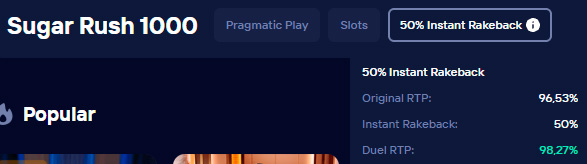
Duel's rakeback tooltip for Sugar Rush 1000 reads:
| Original RTP | 96.53% |
|---|---|
| Instant Rakeback | 50% |
| "Duel RTP" | 98.27% |
No discrepancy — and that is itself informative. Duck Hunters showed that the badge quotes the highest RTP among a game's modes. Sugar Rush 1000 is the clean control: both buys run below the base game (96.52% and 96.44% against 96.53%), so the base is the maximum — and the badge duly shows 96.53%. Compare Sweet Bonanza 1000: the same 96.53% base RTP, but there a buy mode runs higher and the badge shows 96.55%. Two games with the same base and different badges, both explained by one rule — which went on to hold on all eleven games in the series. "Duel RTP" is the interface's own aggregate of RTP plus rebate; we call that figure a conditional effective return, because the rebate accrues outside the game and has to be claimed.
How we tested
Rakeback counter claimed to zero before the block. One block of 100 spins at $0.60 through Hyperplay in the base game, no feature buys — $60.00 of turnover. Per Hyperplay's totals the block returned $27.69 in winnings and closed at $647.93 from an opening balance of $680.24; the ledger reconciles to the cent: 680.24 − 60.00 + 27.69 = 647.93. The per-spin table is archived as evidence.
Expected $1.04, accrued $1.04
| Turnover | $60.00 |
|---|---|
| Rakeback accrued | $1.04 |
| Expected (badge = game rules, RTP 96.53%) | $1.04 |
| Difference | $0.00 |
| Status | Matched |
With badge and rules in agreement there is only one prediction to test, and the accrual landed on it exactly: 50% of the 3.47% house edge on $60.00 of turnover is $1.04, and $1.04 is what the counter showed when the hundredth spin settled.
What it costs across the modes
| Mode | RTP | House edge | Rebate (from the badge) | Net edge |
|---|---|---|---|---|
| Base game (the badge mode) | 96.53% | 3.47% | 1.74% | 1.74% |
| Buy Free Spins, 100x | 96.52% | 3.48% | 1.74% | 1.75% |
| Buy Super Free Spins, 500x | 96.44% | 3.56% | 1.74% | 1.83% |
The rebate is the same 1.74% of turnover in every mode, because it runs off the badge — and here the badge is the base game, so buying the feature costs a little more per dollar than spinning: one cent per $100 for the 100x buy, nine cents for the super buy. That is the opposite of Sweet Bonanza 1000, where the 500x buy is the badge mode. Halved is still not cheap: a low-edge table game costs less. Whatever the mode, the cost is (edge − rebate) × turnover; the rakeback guide has the arithmetic for any game. Net edge is rounded to two decimals.
Session outcome: 46.2%
The block paid back $27.69 on $60.00 wagered. Eleven sessions in the series span 26.5% to 593.2%, which is simply what 5/5 volatility does to 100-spin samples; none of those figures estimates the long-run RTP of any game. The constant across all of them is the rakeback, which has landed on its predicted value every time. Turnover drives the counter; outcomes don't.
The fine print
One account, one date, USDT, with the 50% badge active — rates could differ by account, region or time, and Duel's terms can change after publication. The conclusions cover the accrual formula only, not session outcomes. The best-mode pattern remains an observed regularity across eleven games, not a documented policy; agreement between badge and rules here is consistent with the pattern, not final proof of it.
Verdict
On this account, on this date, Sugar Rush 1000 accrued instant rakeback at exactly 50% of the badge's house edge across the tested block, matched to the cent. The advertised number checks out — and for once the badge and the game rules told the same story, precisely where the pattern from the earlier tests says it should be.
Related: the game's row in the catalog · its two buys on the feature-buy page · the full results table on the rakeback guide.
Self-funded, documented and reproducible. This test was paid for by the site owner; Duel provided no balance or compensation for it. This page contains affiliate links; affiliate relationships do not alter our protocol, formulas or published numbers. Original screenshots and per-spin logs are archived. Full protocol: rakeback test methodology.